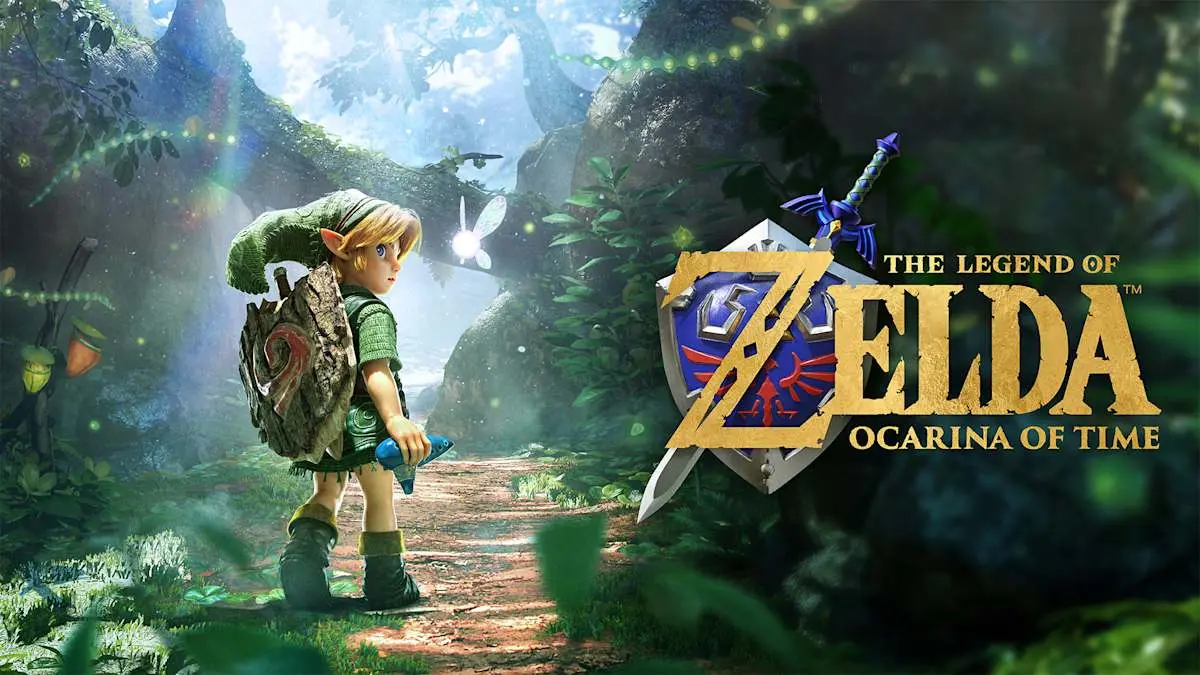
I never write about video games on this blog. But on November 5, 2026, Nintendo releases a remake of The Legend of Zelda: Ocarina of Time on Switch 2, and I can't pretend it isn't happening. For me, this game is a Proustian madeleine. And this time it comes with jam on top, served in a very pretty shape.
In brief
- The game: Ocarina of Time, released at the end of 1998 on Nintendo 64, is the first 3D Zelda.
- The remake: a full rebuild, exclusive to Switch 2, out on November 5, 2026.
- The 1998 tricks: around 20 frames per second, a 4 KB texture cache, fog to hide the horizon, pre-rendered backgrounds and doors that double as loading screens.
- The score: 99/100 on Metacritic, the highest average ever for a video game.
- What the remake brings: 60 frames per second (measured by Digital Foundry), free camera, manual jump, time that flows even in towns, voices, orchestra, rebuilt graphics.
- My angle: a childhood memory, revisited with a developer's eyes.
Eleven years old, first year of middle school
I was 11 or 12, in my first year of middle school, and I had the game. My own copy, not a friend's.
From the first minutes, I loved it. Link asleep in his treehouse, lost in a nightmare. Navi rushing in to drag him out of bed. I didn't know yet that I would spend weeks in that world, but I was already in it.
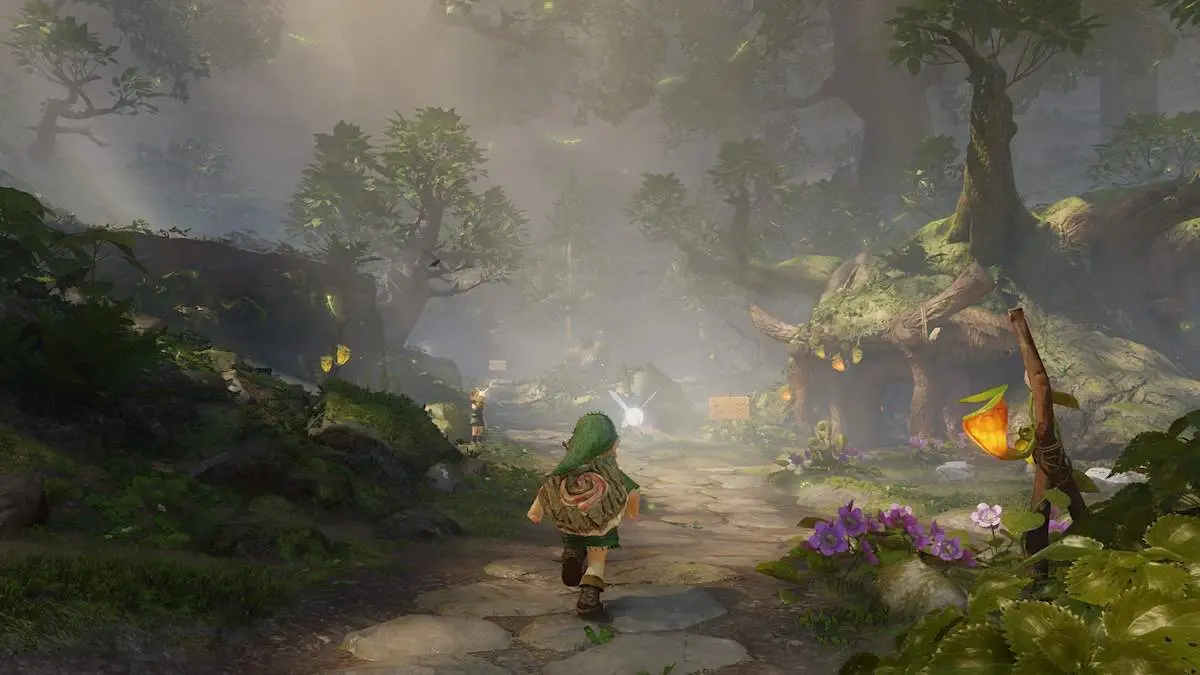 Kokiri Forest in the Switch 2 remake. In 1998 it was the same path, with far fewer polygons. Image: Nintendo
Then came that moment. Link pulls the Master Sword in the Temple of Time, the screen goes white, and he wakes up seven years later. An adult. His shouts are no longer a kid's, his voice has broken. For an 11-year-old, it was a real cliffhanger. The hero had grown up all at once, and I was still 11 in front of my TV.
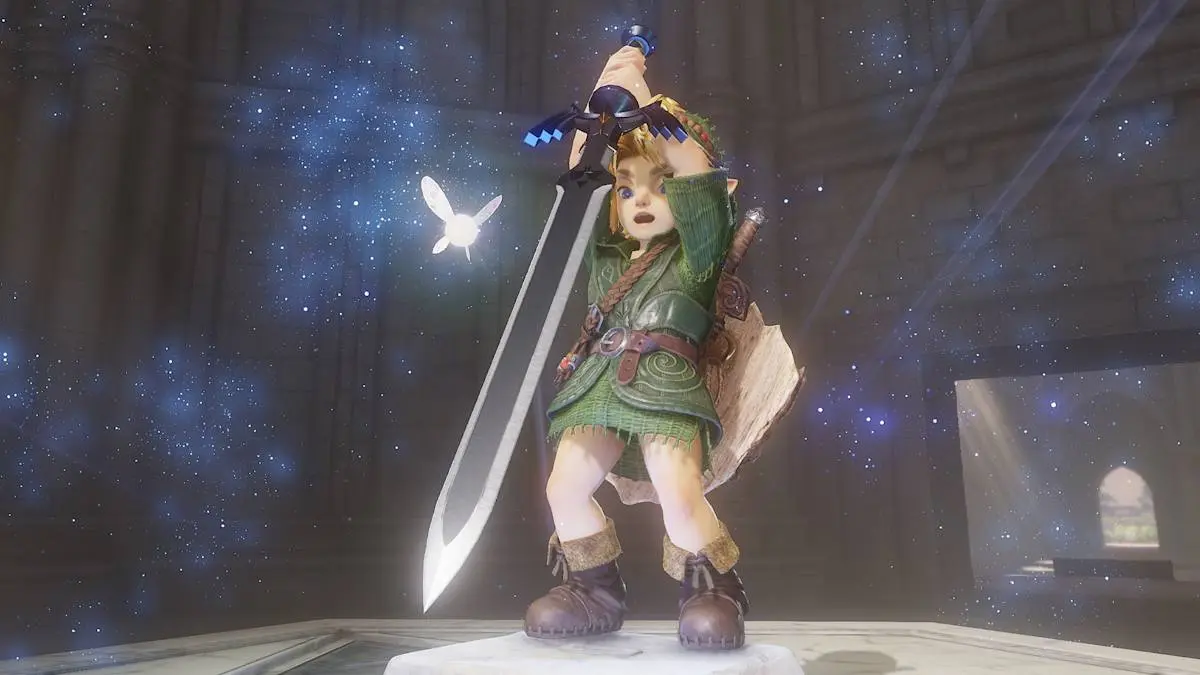 The moment everything shifts: the Master Sword, right before the seven-year jump. Image: Nintendo
The Forest Temple, seven years later in the game, hit me even harder. You go back to where it all started, and Saria hasn't grown. The Kokiri never age. Link has changed. It was the first time a game made me feel something close to nostalgia, when I was too young to know what that was.
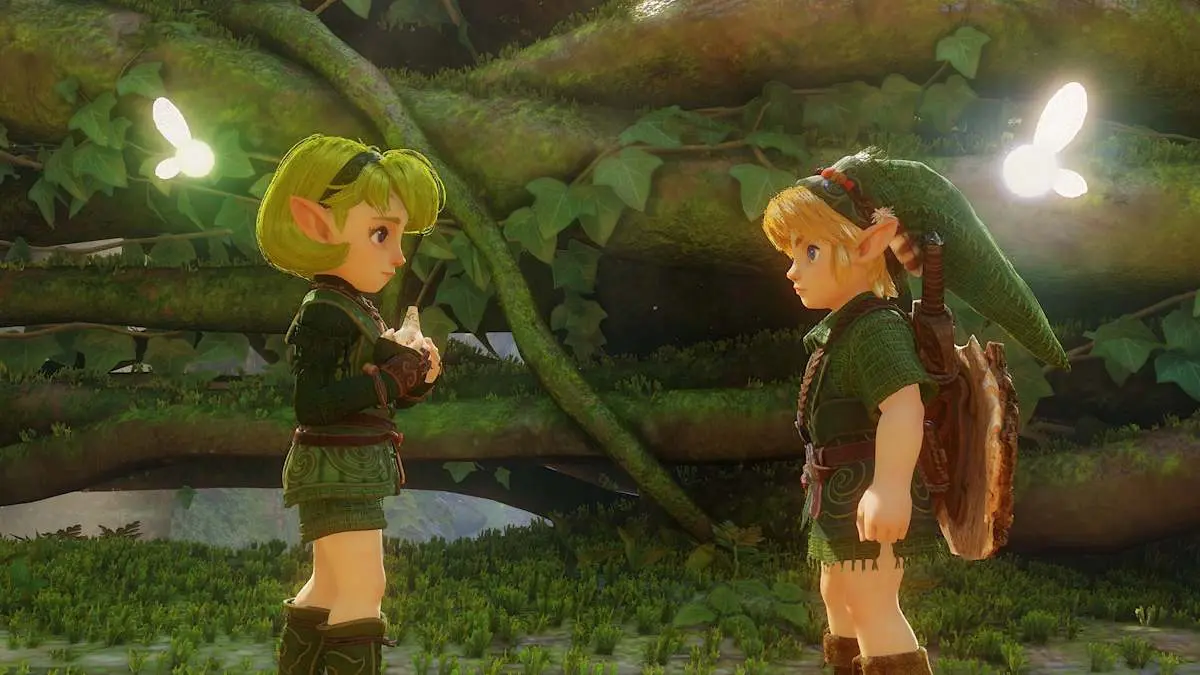 Saria and Link, before the time jump. She won't grow up, he will. Image: Nintendo
I had nothing to compare it to. I didn't know what a draw distance was. To me, it was simply beautiful.
What the Nintendo 64 was hiding from me
I discovered what was behind the scenes much later, in a YouTube video that took the game apart. And I realized my memories were built on a series of magic tricks.
The first one is the camera. It only shows what was built. Everything is framed and cropped so your eye never lands on an empty spot. Outside the frame, there is often nothing at all.
The second one is layering. The scenery is stacked like a theater set: real 3D up front, very simplified models further away, and a painted backdrop at the very back. Seen from where Link stands, it looks like a huge world. Seen from the side, it would fall apart.
The rest is the list of compromises I learned about at the same time:
- Fog. On Hyrule Field or in the woods, it hides the limit of the draw distance. What I took for atmosphere was also a patch.
- Pre-rendered backgrounds. The Castle Town market and the outside of the Temple of Time are still images with a locked camera. You think you're walking through a 3D town, you're actually walking in front of a painting.
- Doors. They open slowly, with a little bit of staging. Meanwhile, the console loads the next room.
- Frame rate. The game shows 20 frames per second: one new image every three refreshes of a 60 Hz TV.
- Textures. The Nintendo 64 only has a 4 KB texture cache. Hence those blurry surfaces my child brain filled in on its own.
And one compromise was about me specifically. In France, I played the PAL version, at 50 Hz. It ran about one sixth slower than the American or Japanese version, at roughly 17 frames per second, with black bars at the top and bottom of the screen. So I played the most constrained version of the game without knowing it, and I loved it anyway.
And yet I wasn't the only one who found it beautiful. Ocarina of Time has a Metascore of 99 out of 100. Metacritic is a site that gathers press reviews and computes a weighted average, the Metascore. As of March 2025, Guinness World Records still recognized it as the only video game to reach 99. With its 20 frames per second, painted backdrops and fog, it was already a masterpiece.
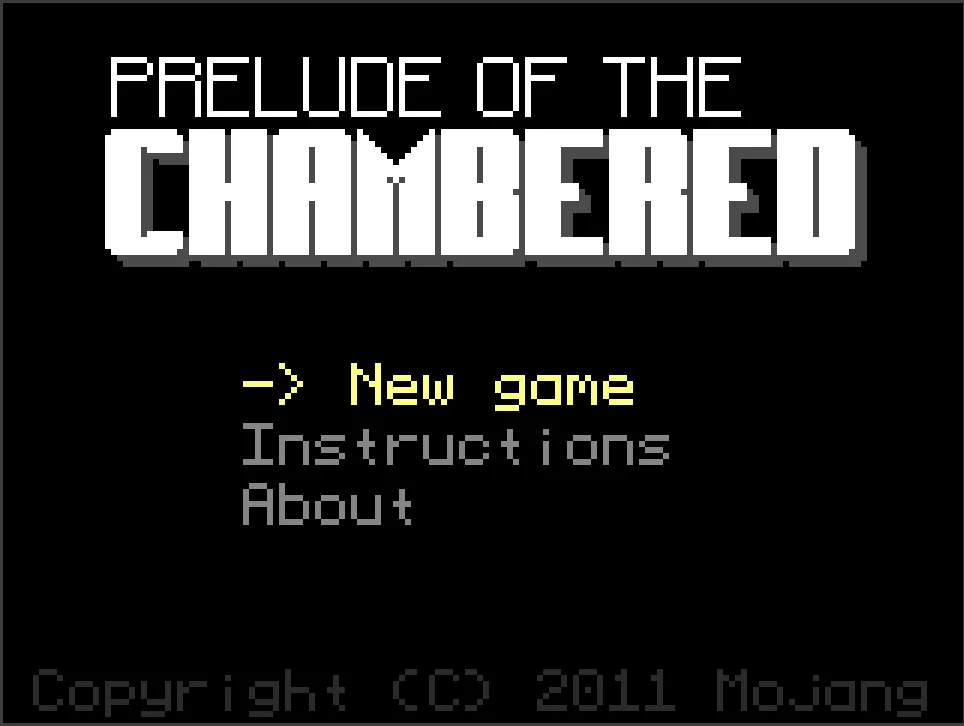
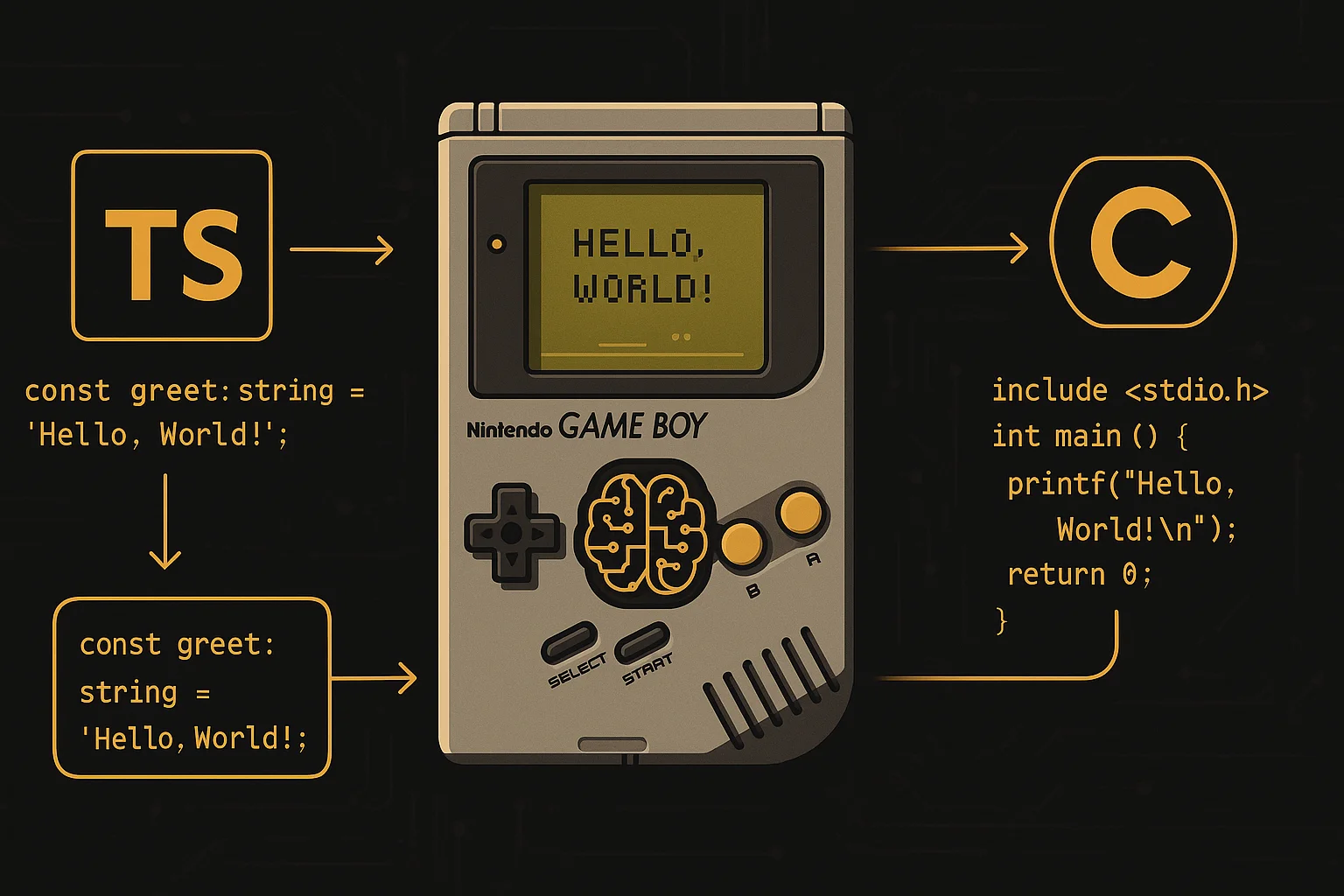
None of this spoiled the memory. It made it more impressive. Now that this is my job, I know what it means to fit inside constraints like these. When I rewrote Prelude of the Chambered in TypeScript, I found that same joy of watching an old engine do a lot with very little. Ocarina of Time is that, at the scale of a whole world.
The jam: what the remake changes
Let me be clear: a remake doesn't fix anything. The 1998 game was a masterpiece and still is. The remake rebuilds that same game with 2026 means. Nintendo's announcements and the first hands-on previews published on October 14 show that many of the new features touch exactly the places where the N64 had to compromise.
The overview trailer Nintendo released on October 14, 2026.
| On Nintendo 64 (1998) | On Switch 2 (2026) |
|---|---|
| Market as a still image, locked camera | Castle Town rebuilt in real 3D, better connected to the rest of the world |
| Automatic camera, Z-targeting essential | Free camera on the right stick |
| Automatic jump at ledges | Manual jump and sprint |
| Time stops in towns | Continuous day/night cycle, towns included |
| Music generated by the console | Orchestral soundtrack |
| Text-only dialogue | Fully voiced cutscenes |
| Tiny textures | Rebuilt graphics: models, lighting, materials |
| 20 frames per second (about 17 in PAL) | 60 frames per second at 1080p, according to Digital Foundry |
There is also new content, according to the announcements and previews:
- A quest menu, "Threads of Time", that tracks objectives, recaps the story when you pick up a save, and fills in a woven picture as you progress.
- The "Hall of Fallen Heroes", a room displaying statues of defeated monsters, with boss rematches.
- Reworked bosses, with new attacks for King Dodongo and Volvagia and new phases for the Poe Sisters.
- A redesigned Forest Temple, closer to a haunted house, with modified puzzles.
- A fifth bottle to earn at the Castle Town bazaar, new characters and longer dialogue.
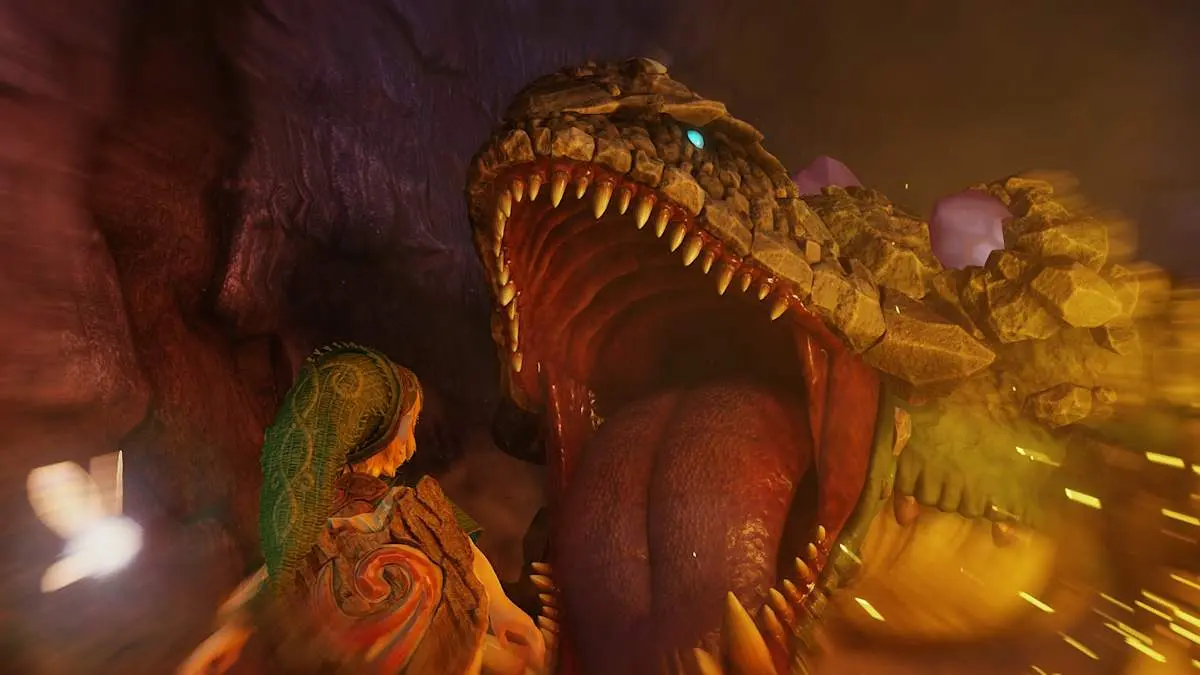 King Dodongo returns with new attacks. Image: Nintendo
Run, jump, hum
Reading the hands-on previews, I realized how much the way you play is changing.
On N64, Link had no sprint. To go faster, you chained rolls, and everybody crossed Hyrule Field that way. The remake adds a real sprint. Rolling is still there, for anyone who wants to play like it's 1998.
Jumping was automatic: you ran toward an edge and Link leapt on his own. There is now a dedicated button, and the automatic jump at platform edges is gone. One previewer admits falling several times during the demo before getting used to it. I have a feeling the same will happen to me.
The rest follows the same logic. Swimming has been heavily reworked, and you can dive to pick up items from the bottom. You swap items without going through the pause menu, where the N64 made you juggle three C buttons. And the doors, the ones that hid the loading, Link now actually pushes them open with his hands.
Combat keeps Z-targeting, but it's faster. Enemies attack quicker, Link chains hits, and the spin attack sends out waves of energy. As for voices, the big cutscenes are voiced, the Great Deku Tree included. Secondary characters mostly speak in text. And Navi still shouts "Hey, listen!".
Then there's the feature that made me smile. On N64, you played the ocarina with the A and C buttons. On Switch 2, the buttons still work, but you can also hum the melody into the console's microphone, or play it on a real instrument. The game recognizes the tune and Link plays it on the ocarina, as long as he has already learned it. HORI even sells an electronic ocarina, at $49.99, that plays the game's 12 songs so the microphone can pick them up.
How many kids hummed Saria's Song or Zelda's Lullaby outside the game? This time, it actually counts.
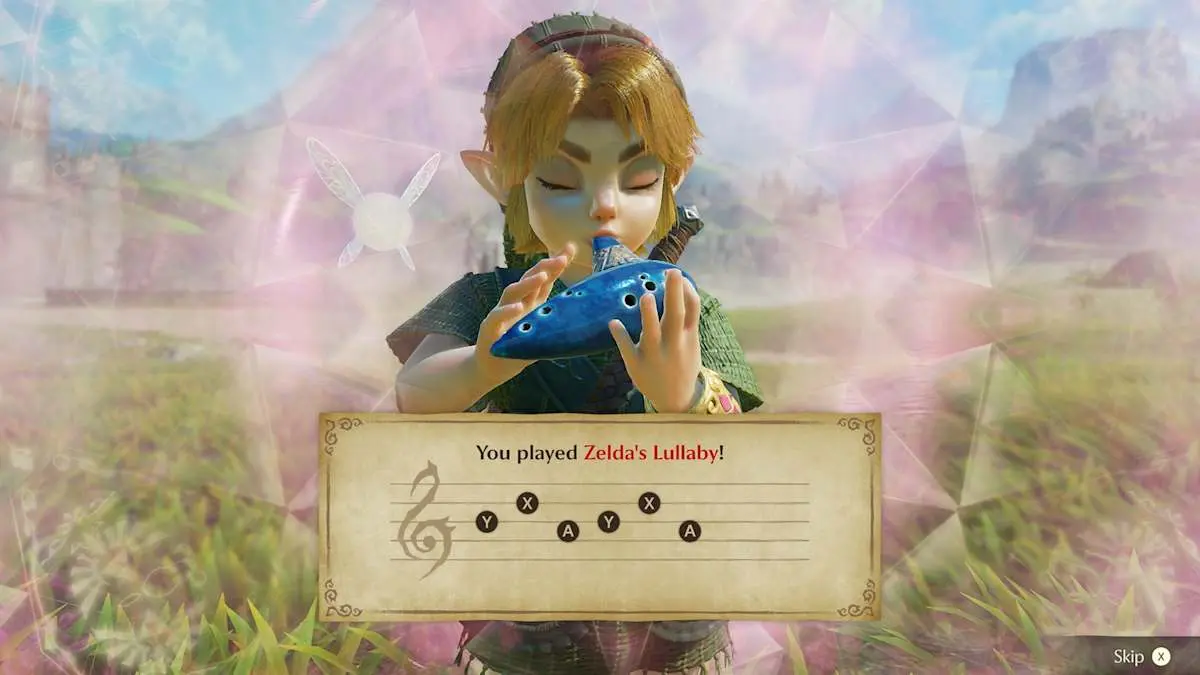 Zelda's Lullaby on the ocarina. On Switch 2 you can also hum it into the microphone. Image: Nintendo
To see the game in motion, series producer Eiji Aonuma walked through it in a commented demo:
Eiji Aonuma's gameplay demonstration, published by Nintendo.
On the technical side, Nintendo announces HDR and VRR. Previews also point out two weak spots: shimmering on hair and foliage, and a Hyrule Field that still feels small next to Breath of the Wild. Nintendo hasn't published official resolution or frame rate figures. Digital Foundry, a team that specializes in technical analysis of games, measured 1080p at 60 frames per second in the September footage, without DLSS (Nvidia's upscaling technique). That's three times as many frames as on N64, and more than three and a half times the PAL version I grew up with.
Will I miss the fog?
That's the question I've been asking myself since the announcement. The 1998 fog was a constraint, and it became part of my memory. The remake will show me the horizon of Hyrule Field for the first time, and I don't know yet whether I'll find it more beautiful or just different.
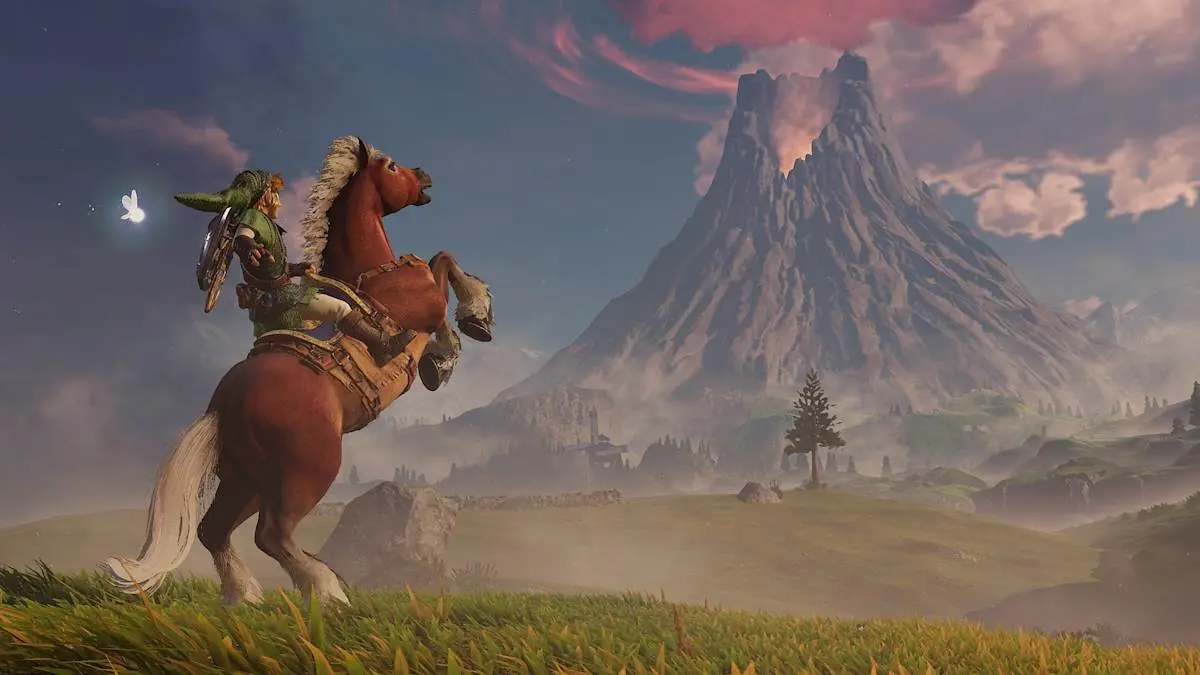 Hyrule Field and Death Mountain, no fog. Image: Nintendo
I'll go back to Kokiri Forest, climb up to the Forest Temple and find Saria, who still won't have grown. I'll be 28 years older than the middle-school kid in front of his TV. Same game, without the strings. And I really want to know what that feels like.
Frequently asked questions
- When does the Zelda Ocarina of Time remake come out?
- The remake of The Legend of Zelda: Ocarina of Time comes out on November 5, 2026, exclusively on Nintendo Switch 2. Nintendo announced it in June 2026 and confirmed the date during the Zelda 40th Anniversary Direct on September 8, 2026.
- What changes in the Ocarina of Time remake?
- The Switch 2 remake of Ocarina of Time fully rebuilds the graphics and adds a free camera, manual jumping and sprinting, a continuous day/night cycle even in towns, voiced cutscenes and an orchestral soundtrack. It also adds a quest menu, microphone recognition of songs and timed boss rematches.
- Can you play the ocarina by humming in the Ocarina of Time remake?
- Yes. In the Switch 2 remake of Ocarina of Time, you can hum a melody into the console's microphone, or play it on a real instrument: the game recognizes it and Link plays it on the ocarina, as long as he has already learned it. Button inputs still work.
- What is Ocarina of Time's Metacritic score?
- The Legend of Zelda: Ocarina of Time (Nintendo 64, 1998) has a Metascore of 99 out of 100, the highest in Metacritic's history. Metacritic computes a weighted average of press reviews. As of March 2025, Guinness World Records recognized it as the only video game to reach 99.
- Does the Ocarina of Time remake run at 60 frames per second?
- According to Digital Foundry's analysis of the September 2026 footage, the Switch 2 remake of Ocarina of Time runs at 1080p and 60 frames per second, without DLSS. Nintendo hasn't published official figures. The Nintendo 64 version ran at 20 frames per second, and about 17 in Europe.
- Why was there so much fog in Ocarina of Time on Nintendo 64?
- On Nintendo 64, the fog in Ocarina of Time hid the limit of the draw distance: the console could not render the whole landscape far away. The developers turned it into part of the atmosphere instead of a visible flaw.
- What technical compromises did Ocarina of Time make on Nintendo 64?
- Ocarina of Time ran at 20 frames per second (about 17 in Europe) with a 4 KB texture cache. The game used pre-rendered backgrounds with fixed cameras (the market, the outside of the Temple of Time), slow door animations to hide loading, and fog to limit the draw distance.
- Was the European version of Ocarina of Time different?
- Yes. In Europe, Ocarina of Time ran in PAL 50 Hz. The game ran about one sixth slower than the American or Japanese version, with black bars at the top and bottom of the screen.