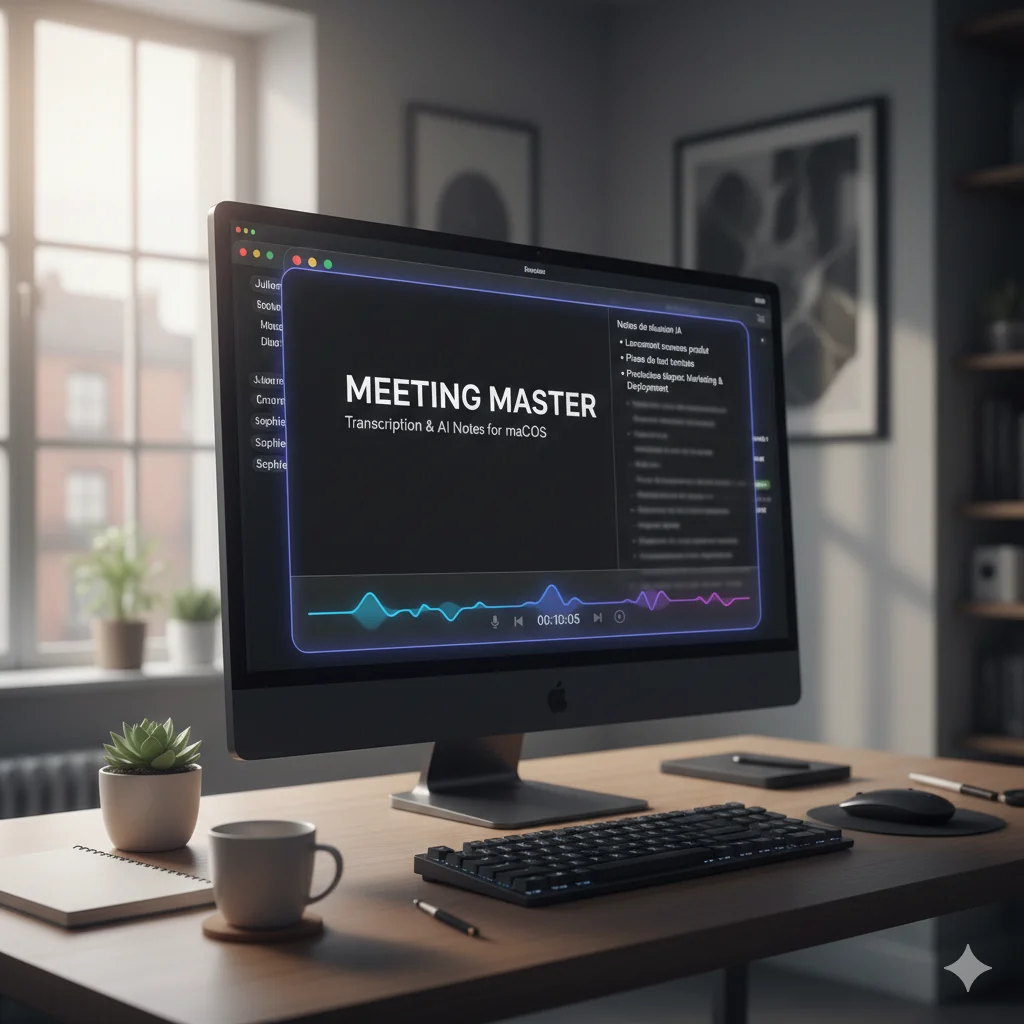
How many meetings do you have this week? And how many notes did you actually take? Between actively participating and taking detailed notes, you have to choose. This frustration led to Sourdine — with one major constraint: everything must stay on my machine.
The Problem: Cloud AI vs Privacy
Transcription solutions (Otter.ai, Fireflies, Teams/Meet transcriptions) share one thing in common: your conversations go through their servers. Problematic for:
- Strategic business meetings
- Confidential interviews
- Medical or legal discussions
- Anything that's none of Google, Microsoft, or a startup's business
Not to mention the monthly subscriptions piling up.
The Solution: All Local, Zero Compromise
Sourdine runs two AI models directly on your Mac:
| Model | Size | Role |
|---|---|---|
| Parakeet TDT (NVIDIA) | 640 MB | Speech-to-text transcription |
| Mistral 7B | 4.4 GB | Summaries, key points, contextual chat |
No internet connection needed after initial download. Your data never leaves your machine.
How It Works
Smart Audio Capture
Sourdine captures two sources simultaneously:
Microphone (your voice)  →  ┐
                            ├→  Audio mixer  →  Transcription
System audio (Teams)     →  ┘
This dual capture uses ScreenCaptureKit (macOS 14.2+). I developed a native module in Rust with napi-rs to integrate it with Electron.
Transcription Pipeline
| Step | Technology | Function |
|---|---|---|
| 1. Voice detection | Silero VAD | Identifies speech vs silence/noise |
| 2. Transcription | Parakeet TDT via sherpa-onnx | Converts audio to text |
| 3. AI notes | Mistral 7B via node-llama-cpp | Generates summary, actions, key points |
STT runs in a separate Node.js worker to avoid blocking the UI.
Note Generation
Mistral 7B analyzes the transcription to extract:
- Summary of the discussion
- Key points covered
- Action items with assigned people
- Title automatically generated
You can also ask questions: "What did Pierre say about the budget?"
All meetings are indexed via SQLite FTS5 (full-text search) and can be exported as Markdown or plain text.
Technical Architecture
┌──────────────────────────────────────────────────┐
│  Electron Main Process                           │
│  ├── NestJS Backend (dependency injection)      │
│  ├── stt-worker (sherpa-onnx, isolated process) │
│  ├── llm-worker (node-llama-cpp, isolated)      │
│  └── SQLite (local storage, FTS5 search)        │
└──────────────────────────────────────────────────┘
                       │ IPC
┌──────────────────────┴───────────────────────────┐
│  Renderer Process (Angular 21)                   │
└──────────────────────────────────────────────────┘
Tech Stack
| Layer | Technologies |
|---|---|
| Desktop | Electron 34 |
| Frontend | Angular 21, Signals, SCSS |
| Backend | NestJS 11, RxJS |
| Database | SQLite + FTS5 (full-text search) |
| Audio | Rust/napi-rs + ScreenCaptureKit |
| Build | Nx monorepo, Vite, Electron Forge |
Why These Choices?
- Electron — Native system access (audio, files), TypeScript ecosystem
- NestJS in Electron — Modular architecture, dependency injection
- Separate workers — AI model isolation (crash-safe)
- Rust for audio — Native performance, ScreenCaptureKit integration
Performance on Apple Silicon
| Metric | MacBook Pro M2 |
|---|---|
| Transcription | Real-time |
| LLM generation | ~20 tokens/s |
| Peak RAM | ~4 GB |
| Active CPU | 15-30% |
Apple Silicon chips with their Neural Engine are perfectly suited for this.
What I Learned
1. Audio Is Complicated
- Resampling (48kHz → 16kHz)
- Format conversion (Float32 → Int16 PCM)
- Multi-source mixing
- Buffer and latency management
2. Local AI Has Constraints
- 16 GB RAM minimum
- Initial loading takes several seconds
- Quality depends on quantization (Q4_K_M = good compromise)
3. Electron Is Not Dead
Despite criticism about memory usage, still the best choice for cross-platform desktop with native access.
Installation
Requirements
| Component | Minimum | Recommended |
|---|---|---|
| macOS | 14.2 (Sonoma) | 15+ (Sequoia) |
| Processor | Apple Silicon (M1) | M2/M3/M4 |
| RAM | 16 GB | 32 GB |
| Storage | 10 GB | 20 GB |
Download the DMG
- Open the DMG and drag Sourdine to Applications
- Run this command (app is not signed):
xattr -cr /Applications/Sourdine.app - Launch Sourdine — The wizard will download AI models (~5 GB)
- Grant Microphone and Screen Recording permissions on first launch
Beta: This version is under active development. Feedback is welcome via GitHub Issues.
Conclusion
Sourdine was born from a personal need: keeping control over my data while benefiting from AI. The project is open source and contributions are welcome.
If you share this concern for privacy, I hope this project will be useful to you.