
On Arrakis, a storm rarely arrives all at once. The wind shifts, the air thickens, a dark line rises on the horizon, and people who live in the desert know that by then, they should already have chosen their shelter.
Arrakis is the desert planet of Dune, Frank Herbert's 1965 novel. The whole economy of the Empire depends on a single resource there, the spice, extracted at great cost under the constant threat of storms. The image fits AI uncannily well: an entire economy hanging on one scarce, expensive resource, compute, and companies investing fortunes on the bet that the sky will stay clear.
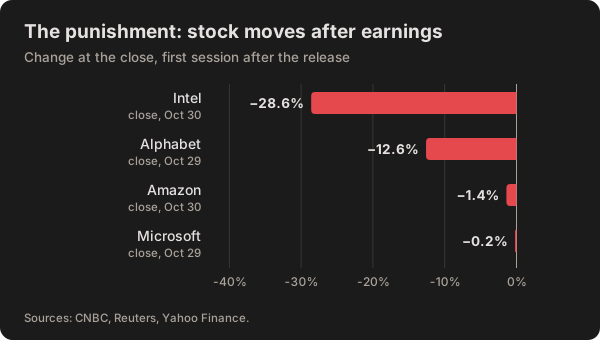
This week had that color. On October 29, Alphabet lost 12.6%. The next day, Intel fell 28.6% and the Nasdaq 2.9%. That same Friday morning, Insee announced that French GDP had shrunk. None of this is a bubble bursting yet. These are gusts, and they tell you which way the wind is blowing.
In brief
- What: a sharp correction in AI stocks on October 29 and 30, 2026, triggered by results from Alphabet, Amazon and Intel. Not yet a bubble bursting.
- Key figures: Alphabet -12.6% in one session and -$9.1 billion of free cash flow in Q3. Intel -28.6%, its worst day since 1974. Nasdaq -2.9% on October 30.
- What the market punished: the cost of AI. Demand keeps growing (Google Cloud +103%, AWS +39%, Azure +48%).
- The most worrying sign: credit. CoreWeave and Oracle are paying for their debt at the price of fragile companies.
- In France: GDP -0.1% in Q3, unemployment at 8.3%, 10-year OAT yield above 5%. And Capgemini is cutting 2,409 jobs in France while growing worldwide.
The wind shifts
The first signs came from the debt market, which few people watch. In mid-October, the cost of insuring against a default by CoreWeave, which rents computing power to AI companies, went above 1,000 basis points according to LSEG data. That is distressed territory. Oracle's, which builds data centers for OpenAI, hit a record 288 basis points on October 15. An Evercore ISI trader quoted by CNBC put it in two words: the market is saying "no más" to AI debt without operating cash flow behind it.
Elsewhere, the storm has already passed. In China, the STAR50 AI index has lost about 40% since its July peak, wiping out some $480 billion according to Yahoo Finance.
At the center of it all is compute, the spice of this economy. According to estimates in circulation, Alphabet, Amazon, Microsoft and Meta will spend between $725 and $760 billion on capital expenditure this year. Nvidia is financing up to $105 billion for an OpenAI data center in Ohio, according to CNBC. The supplier lends to its customer so the customer can buy its product. That kind of arrangement holds up fine as long as money keeps flowing. The bill is physical too: data centers used 448 TWh in 2025 and are projected to reach 945 TWh in 2030, roughly Japan's consumption, as I detailed in my piece on AI's ecological footprint.
The first gusts
They came with quarterly earnings. On the evening of October 28, Alphabet reported 103% growth at Google Cloud. But the group spent $51.4 billion on capital expenditure in the quarter, leaving free cash flow at -$9.1 billion, far from what analysts expected. The 2026 budget stays at $195-205 billion, and management expects a "significant" increase in 2027. The next day, the stock lost 12.6% and nearly $500 billion in value, its worst session since going public.
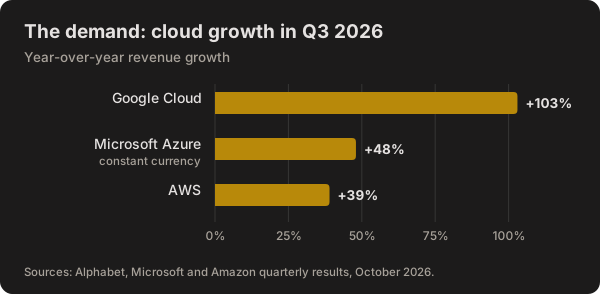
Amazon followed on the evening of the 29th. AWS posted its fastest growth since late 2021, at 39%, with a $578 billion backlog. But trailing twelve-month free cash flow fell to -$42.4 billion. The stock fell as much as 7% after the close, before limiting the loss to 1.4% on Friday.
Intel, on the 30th, is a separate case. Its 28.6% drop, which CNBC tied to the PC slowdown, also stems from a manufacturing incident, with no direct link to AI. In this climate, the market didn't sort things out.
Microsoft was spared. Azure grew 48%, capital spending came in below what the company had guided, and free cash flow beat expectations by $10 billion. The stock rose as much as 4% after the release, then ended the next session almost flat (-0.2%), the day Alphabet lost 12.6%. The gusts hit those who pay for AI without being able to show the return yet.
Last year, I wrote about Sam Altman's statements on the bubble. The OpenAI CEO spoke of a "grain of truth" that gets smart people overexcited. The grain of truth is still there, as cloud growth rates show. Its price is what worries people.
What would be swept away
The S&P 500 lost only 1.8% on October 30, and most analysts quoted by CNBC call this a correction like others before it. For the real storm to arrive, funding would have to dry up: a heavily indebted player unable to refinance, an OpenAI partner pulling out, or a giant announcing it is cutting capital spending. A bubble usually bursts when money stops flowing.
If it came, it would first take whatever has no foundations: compute providers financed on credit, and hardware suppliers whose entire growth depends on data centers. It would also hit Anthropic's IPO, expected around November 16, whose S-1 I went through this week. Listing on the Nasdaq in this climate will be a test.
France, exposed
France goes into this period with few reserves. On October 30, Insee reported that GDP fell 0.1% in the third quarter, after stagnating in the second, and unemployment stood at 8.3% in the second quarter. Since October, the state has been borrowing at more than 5% over ten years, a first since 2002 according to Boursorama. In August, ECB economists warned that if tech valuations corrected, European authorities would have little room to cushion the shock (CNBC). For France, the danger would be an AI correction driving investors away from anything that looks fragile, government debt included. The Paris stock exchange ended October almost flat: AI hardware names fell, IT services stocks rose.
The ground after
A storm moves things as much as it destroys them. When the wind drops, the terrain has changed. That is already happening to tech jobs, before the storm is even here.
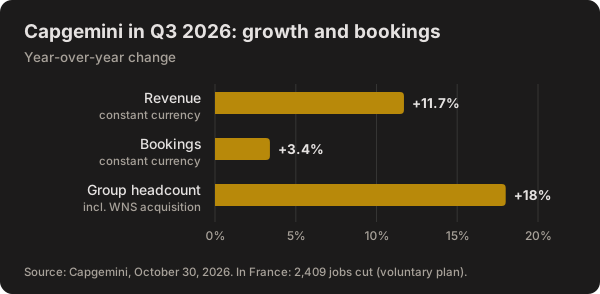
On October 30, Capgemini reported quarterly revenue of €6.07 billion, up 11.7% at constant exchange rates, and raised its full-year target. The group has 417,500 employees, 18% more than a year ago, mostly thanks to the acquisition of WNS, which is largely based in India. In France, it signed a collective voluntary departure agreement in May covering 2,409 jobs, about 7% of its French workforce. One figure goes almost unnoticed: bookings grew only 3.4%, three times slower than revenue.
The rest of the sector is moving cautiously. Numeum, the French digital industry body, forecasts 3% growth for the French digital market in 2026, but only 1.4% for IT services firms, and 35% of them expect lower margins. Sopra Steria posted 4.3% organic growth in the third quarter.
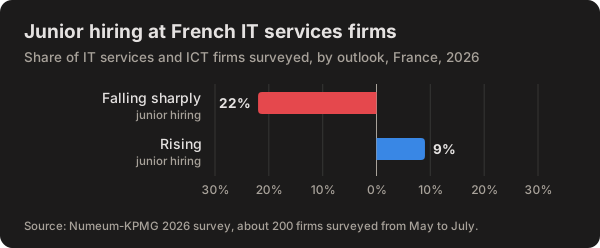
The youngest feel the ground move the most. According to the 2026 Numeum-KPMG survey, 62% of French IT services firms say AI is already weighing on their hiring, 47% require AI skills from the start of a career, and 22% see junior hiring falling sharply, versus 9% rising. In the United States, a Stanford study based on ADP payroll data found employment 19% lower in June 2026 among 22-25 year-olds in AI-exposed jobs. According to Indeed, 71% of the increase in developer job postings between May 2025 and May 2026 was for senior roles. The French executive recruitment agency Apec still forecasts about 61,000 IT executive hires in 2026, up 4%, but those projections predate the negative GDP figure.
A market correction would speed this up. Companies under pressure look for savings, and AI is the easiest promise to sell to a board. In my analysis of whether AI will replace developers, I noted that AI excels at repetitive tasks, scaffolding, test generation and documentation, and that the profession is shifting toward architecture. Those are exactly the tasks juniors used to learn on. In May, before the French National Assembly, Arthur Mensch said AI consumption already amounted to 10% of Mistral's payroll (I analyzed that hearing). Behind that ratio, there are jobs.
The profiles that hold are the ones with foundations: architects, tech leads, security and cloud specialists, and people who know how to orchestrate models instead of competing with them. The Forward Deployed Engineer role, which AI vendors are hiring by the hundreds to plug their models into customers' systems, is one example.
What I'm watching
November 3, the US midterm elections, with the risk of escalation with Iran right after. Around November 16, Anthropic's IPO. November 17, Nvidia's earnings. November 27, the detailed French GDP figures, with the budget vote and the spread over Germany in the background.
And above all, two signals worth more than any trading session: a tech giant cutting its capital spending, or an indebted player like CoreWeave failing to refinance. If either shows up, it will no longer be gusts. And on Arrakis, once the wall of sand is visible, it is already too late to look for shelter.
Figures come from the financial press (CNBC, Reuters, Yahoo Finance, Bloomberg, Boursorama), Insee, Numeum, Apec and company releases, accessed on October 30, 2026. Stock moves are closing prices unless stated otherwise.
Illustration: "Le Simoun", lithograph by E. Warnots after Jean Portaels, Salon of 1848 (British Museum, public domain, via Wikimedia Commons).
Frequently asked questions
- Did the AI bubble burst in October 2026?
- No. In late October 2026, AI stocks went through a sharp correction: Alphabet lost 12.6% on October 29, Intel 28.6% and the Nasdaq 2.9% on October 30. But AI demand kept growing and the S&P 500 fell far less (-1.8%). Analysts called it a correction, with more worrying signs of strain in credit markets.
- Why did AI stocks fall in late October 2026?
- Investors punished the cost of AI rather than its demand. Alphabet reported negative free cash flow of $9.1 billion in Q3 2026 despite 103% growth at Google Cloud, and Amazon's trailing twelve-month free cash flow fell to -$42.4 billion. Microsoft, which spent less than expected, was spared.
- What are the warning signs of an AI bubble bursting?
- The most closely watched signals in October 2026 were in credit: CoreWeave's credit default swaps traded above 1,000 basis points and Oracle's hit a record 288 basis points on October 15. A real burst would more likely show up as a heavily indebted player unable to refinance, or a tech giant cutting its capital spending.
- Is France exposed to an AI bubble correction?
- France is exposed mostly indirectly. French GDP shrank 0.1% in Q3 2026 according to Insee, unemployment stood at 8.3% in Q2, and the 10-year OAT yield went above 5% in October for the first time since 2002. In August 2026, ECB economists called a correction in tech valuations likely, warning that European authorities would have little room to cushion its effects.
- Are IT services firms and junior developers at risk?
- Capgemini signed a collective voluntary departure agreement covering 2,409 jobs in France in May 2026, while reporting 11.7% growth in Q3. According to the 2026 Numeum-KPMG survey, 22% of French IT services firms see junior hiring falling sharply versus 9% rising, and 47% require AI skills from the start of a career.